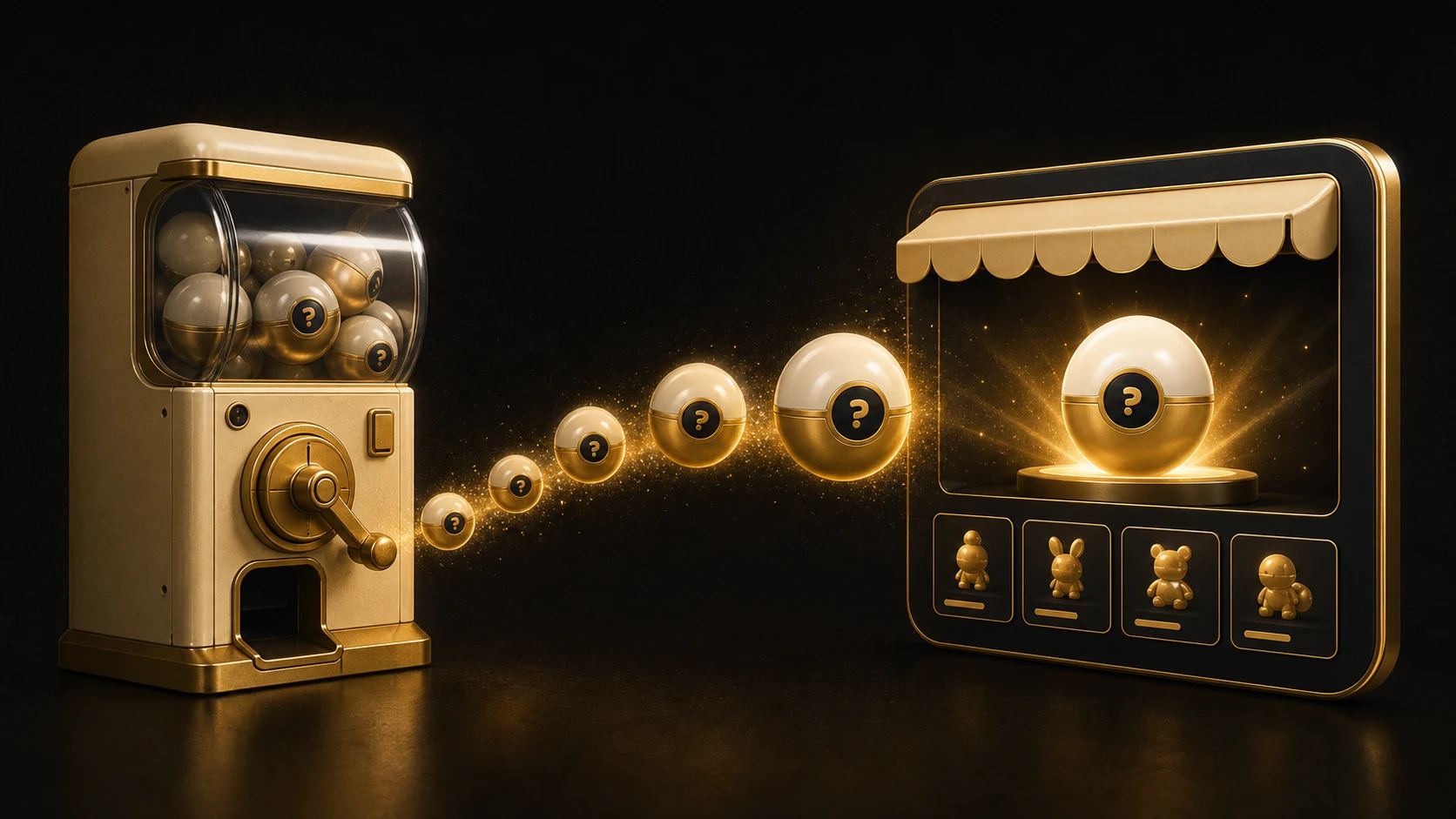
Walk into any arcade, mall, or train station in Japan and you'll find walls of small vending machines filled with plastic capsules. Put in a few hundred yen, turn the crank, and a capsule drops out — gacha-gacha goes the crank, pon goes the capsule. That onomatopoeia is the name: gachapon (also written gashapon, a Bandai trademark, or simply "gacha"). Inside is one toy from a posted set, and you don't know which until you open it.
That one sentence contains the entire mechanic that now powers blind boxes, trading card pack rips, and a growing slice of ecommerce: a known set of real prizes, a fixed price, a random draw, and a reveal that's fun in itself.
A short history
Capsule-toy machines arrived in Japan in the mid-1960s, imported from American gumball-machine vending. What began as cheap trinkets evolved through the 1980s and 90s — when Bandai's Gashapon machines started dispensing finely sculpted anime and video game figures — into a legitimate collectibles industry. Modern gachapon toys are detailed miniatures with production values that rival boxed figures, sold for a few hundred yen precisely because the randomness spreads demand across the whole set.
The word "gacha" later jumped to video games: mobile titles adopted the random-draw mechanic for digital characters and items, which is why gamers know "gacha games" as a genre. But the physical original never went anywhere — Japan's capsule-toy market has kept growing, with dedicated gachapon department stores in Akihabara and Ikebukuro carrying thousands of machines.
Gachapon vs. blind box vs. mystery box
They're the same idea in different packaging, and the terms are drifting together:
- Gachapon is the machine format: a capsule dispensed by a crank, an impulse purchase at a physical location, with the full prize set printed on the machine.
- Blind boxes are the retail-shelf version: identical sealed boxes, one figure from a posted set inside, popularized by Sonny Angel and industrialized by Pop Mart — rarity tiers, "secret" chase figures, whole aisles of them. Labubu made this format a global phenomenon.
- Mystery boxes is the broader Western ecommerce term: any purchase whose contents are revealed after buying, from curated subscription crates to single-item random draws.
What unites them matters more than what separates them: the contents are real and desirable, the possible outcomes are known, and the uncertainty is the entertainment.
Why the crank is so compelling
Psychologists call it variable reward: an unpredictable payoff engages us more than a predictable one. But gachapon's designers understood the details long before anyone formalized them:
- Every outcome is a prize. You always get a real toy from the set — the floor is high, so even an unlucky turn feels fine.
- The set creates the chase. Collectors don't want a figure; they want the last one missing from the shelf, and duplicates become trades.
- Transparency keeps it honest. The machine shows the full lineup. You know exactly what you're chasing and what it could cost.
- The reveal is shared. Cracking a capsule open with friends was social media before social media; unboxing videos are its digital descendant.
How gachapon moved online
The mechanic's migration to ecommerce happened along two tracks. Retail brands — Pop Mart above all — turned blind boxes into a multi-billion-dollar direct-to-consumer business, proving the format works far beyond Japan. Meanwhile trading card platforms rebuilt the capsule machine in software: digital packs of real, vaulted cards, ripped open on screen with published odds. Some of them literally call the product "gacha."
The newest step is gacha for any store. Apps now let a merchant turn their own catalog into the prize pool — commit real inventory, show live odds, and sell the draw as a product. (That's what we build: Chancey brings the mechanic to Shopify with provably fair draws; if you're comparing options, we wrote an honest guide to Shopify mystery box apps.)
The takeaway
Gachapon is sixty years of proof that people love paying a fair price for a fair chance at something real — as long as the set is desirable, the odds are honest, and the reveal is a moment. The machines never needed fixing; the internet just needed time to catch up to the crank.